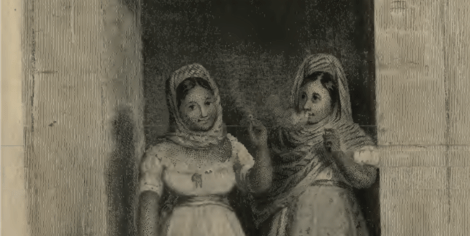
American visitors to 1800s New Mexico found much that was strange to them. “Mud” (adobe) houses, low-impact agriculture, and the clothing styles all gave Anglos something to feel superior about. New Mexican women’s smoking habits were something else entirely. Scandalous, repulsive, and, at least for one young American, titillating.
Seventeen-year-old Lewis Garrard, while decrying the custom, also admitted that smoking enhanced “the charm of the Mexican señoritas, who, with neatly rolled-up shucks [cigarettes] between coral lips,” smiled winningly, “their magically brilliant eyes … searching one’s very soul.” And they offered the treats to him! “These cigarillos they present with such a grace, and so expressive an eye, so musical a tongue, and so handsome a face” that it was impossible to refuse.

What exactly is a cigarillo? Susan Magoffin described them as “a delicate cigar made with a very little tobacco rolled in a corn shuck or bit of paper.” Needless to say, she didn’t try them herself. After all, she was a proper American woman.
The personal production of individual cigarillos was common in the Mexican states of Chihuahua, Sonora, and New Mexico at the time, although elsewhere in the country they were manufactured commercially. The commercial ones always rolled in paper, while New Mexico cigarillos were often made with pre-cut pieces of corn husk, or shuck.
The tobacco used for the New Mexican cigarettes wasn’t necessarily imported, either. They were often made with wild tobacco, or punche. If that wasn’t available, mullein (punchon) was substituted, though the two tasted quite different from each other, with punche being preferred.
The tobacco or its substitute was dried and shredded and carried in a small pouch or silver box. The corn husks or papers for rolling were kept separate, with women often carrying theirs in embroidered cloth cases.
Preparation of the corn shucks consisted of scraping the large pieces smooth, then cutting them into sections roughly three by one and a half inches. When a smoker wanted a cigarette, they (she!) pulled out a piece, moistened it with their mouth, sprinkled tobacco on one end, then rolled it up, pinching the ends to hold the contents.
This process in itself must have been erotic for the teenage Garrard. No wonder he found the cigarillos New Mexican women offered him so irresistible, threatening to draw him into “the giddy vortex of dissipation!”
© Loretta Miles Tollefson
Sources: Stella M. Drumm, ed., Down the Santa Fe Trail and Into Mexico, Diary of Susan Shelby Magoffin, 1846-1847; Marc L. Gardner and Marc Simmons eds, The Mexican War Correspondence of Richard Smith Elliott; Lewis H. Garrard, Wah-to-Yah and the Taos Trail; Albin O. Korte, Tobacco Tales, La Herencia, Summer 2005; Michael Moore, Los Remedios, Traditional Herbal Remedies of the Southwest.
 Fiction and Fact From Old New Mexico